Wednesday, September 9, 2015

Friday, October 24, 2014
Saturday, October 11, 2014
Monday, October 6, 2014
Sunday, October 5, 2014
Thursday, July 24, 2014

Sunday, July 20, 2014
Sacred Feminine
http://soulshaping.com/sacred-feminine-rising/
 Jeff Brown
“We are powerful beyond measure, and so deeply vulnerable at the same time. This may seem like a dichotomy, but it isn’t. We have misunderstood real power. It has been something assertive, non-surrendering, pushing on through. This is not real power. This is simply willfulness. Real power is something else—receptivity, open-ness, the courage to keep your heart open on the darkest of days, the courage to work through unresolved emotions, the strength to feel it all even when the odds are stacked against you. Real power is showing up with your heart on your sleeve and absolutely refusing to waste one moment of your life hidden behind edginess and armour. The art of enheartened presence. Now that’s power.”
Blessings |
Thursday, April 24, 2014
10 'Rules'
10 Rules for Students, Teachers, and Life by John Cage and Sister Corita Kent
by Maria Popova
“Nothing is a mistake. There’s no win and no fail, there’s only make.”
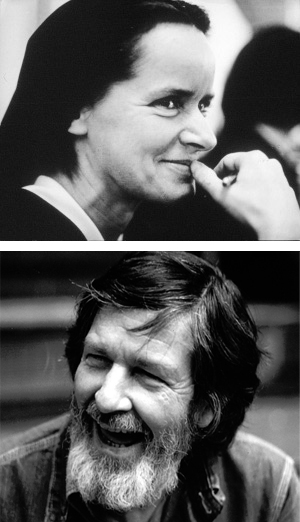 Buried in various corners of the web is a beautiful and poignant list titled Some Rules for Students and Teachers, attributed to John Cage, who passed away twenty years ago this week. The list, however, originates from celebrated artist and educator Sister Corita Kent and was created as part of a project for a class she taught in 1967-1968. It was subsequently appropriated as the official art department rules at the college of LA’s Immaculate Heart Convent, her alma mater, but was commonly popularized by Cage, whom the tenth rule cites directly. Legendary choreographer Merce Cunningham, Cage’s longtime partner and the love of his life, kept a copy of it in the studio where his company rehearsed until his death. It appears in Stewart Brand’s cult-classic Essential Whole Earth Catalog, published in 1986, the year Kent passed away.
The list, which can be found in Sister Corita’s Learning by Heart: Teachings to Free the Creative Spirit (public library), touches on a number of previously discussed themes and materials, including Bertrand Russell’s 10 commandments of teaching, the importance of embracing uncertainty, the pivotal role of work ethic, the intricate osmosis between intuition and intellect, and the crucial habit of being fully awake to everything.
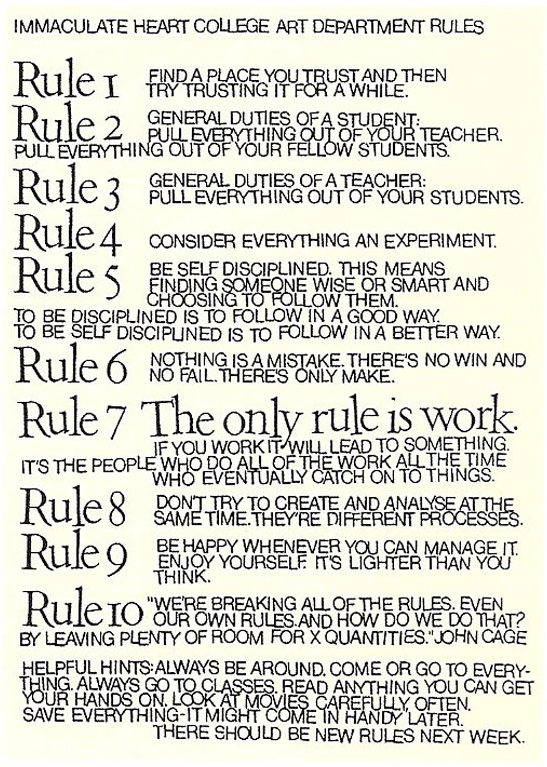
RULE ONE: Find a place you trust, and then try trusting it for awhile.RULE TWO: General duties of a student — pull everything out of your teacher; pull everything out of your fellow students.RULE THREE: General duties of a teacher — pull everything out of your students.RULE FOUR: Consider everything an experiment.RULE FIVE: Be self-disciplined — this means finding someone wise or smart and choosing to follow them. To be disciplined is to follow in a good way. To be self-disciplined is to follow in a better way.RULE SIX: Nothing is a mistake. There’s no win and no fail, there’s only make.RULE SEVEN: The only rule is work. If you work it will lead to something. It’s the people who do all of the work all of the time who eventually catch on to things.RULE EIGHT: Don’t try to create and analyze at the same time. They’re different processes.RULE NINE: Be happy whenever you can manage it. Enjoy yourself. It’s lighter than you think.RULE TEN: “We’re breaking all the rules. Even our own rules. And how do we do that? By leaving plenty of room for X quantities.” (John Cage)HINTS: Always be around. Come or go to everything. Always go to classes. Read anything you can get your hands on. Look at movies carefully, often. Save everything — it might come in handy later.
Friday, April 18, 2014
Monday, April 7, 2014
Monday, December 30, 2013
Monday, December 23, 2013
Describing Water, and Grandfather Canoe
Describing Water: http://www.youtube.com/watch?v=wC90_ciPbBA
http://www.youtube.com/watch?v=Vr9CIRiNu6k
and then the Huskies ... Snow and Wolfie: http://www.youtube.com/watch?v=508xrJNlrE4
http://www.youtube.com/watch?v=Vr9CIRiNu6k
and then the Huskies ... Snow and Wolfie: http://www.youtube.com/watch?v=508xrJNlrE4
Friday, October 4, 2013
Campbell

Joseph Campbell in “The Historical Atlas of World Mythology, Digital Edition: Prologue.” Joseph Campbell Foundation. iBooks.
Sunday, September 22, 2013
I'd almost forgotten the importance of Huxley ... it's time to seek out Koestler too
“There are quiet places also in the mind,” he
said, meditatively. “But we build bandstand and factories on them.
Deliberately—to put a stop to the quietness. We don’t like the
quietness. All the thoughts, all the preoccupation in my head—round and
round continually.” He made a circular motion with his hands. “And
the jazz bands, the music hall songs, the boys shouting the news.
What’s it all for? To put an end to the quiet, to break it up and
disperse it, to pretend at any cost it isn’t there. Ah, but it is, it
is there, in spite of everything, at the back of everything. Lying
awake at night, sometimes—not restlessly, but serenely, waiting for
sleep—the quiet re-establishes itself, piece by piece; all the broken
bits, all the fragments of it we’ve been so busily dispersing all day
long. It re-establishes itself, an inward quiet, like this outward
quiet of grass and trees. It fills one, it grows –a crystal quiet, a
growing expanding crystal. It grows, it becomes more perfect; it is
beautiful and terrifying, yes, terrifying, as well as beautiful. For
one’s alone in the crystal and there’s no support from outside, there’s
nothing external and important, nothing external and trivial to pull
oneself up by or to stand up, superiorly, contemptuously, so that one
can look down. There’s nothing to laugh at or feel enthusiastic about.
But the quiet grows and grows.
 Beautifully and unbearably. And at
last you are conscious of something approaching; it is almost a faint
sound of footsteps. Something inexpressibly lovely and wonderful
advances through the crystal, nearer, nearer. And oh, inexpressibly
terrifying. For if it were to touch you, if it were to seize and engulf
you, you’d die; all the regular habitual, daily part of you would die.
There would be and end of bandstands and whizzing factories, and one
would have to begin living arduously in the quiet, arduously n some
strange unheard-of manner. Nearer, nearer come the steps; but one can’t
face the advancing thing. One daren’t. It’s too terrifying; it’s too
painful to die. Quickly, before it is too late, start the factory
wheels, bang the drum, blow up the saxophone. Think of the women you’d
like to sleep with, the schemes for making money, the gossip about your
friends, the last outrage of the politicians. Anything for a diversion.
Break the silence, smash the crystal to pieces. There, it lies in
bits; it is easily broken, hard to build up and easy to break. And the
steps? Ah, those have taken themselves off, double quick. Double
quick, they were gone at the flawing of the crystal. And by this time
the lovely and terrifying thing is three infinities away, at least. And
you lie tranquilly on your bed, thinking of what you’d do if you had
ten thousand pounds and of all the fornications you’ll never commit.”
Beautifully and unbearably. And at
last you are conscious of something approaching; it is almost a faint
sound of footsteps. Something inexpressibly lovely and wonderful
advances through the crystal, nearer, nearer. And oh, inexpressibly
terrifying. For if it were to touch you, if it were to seize and engulf
you, you’d die; all the regular habitual, daily part of you would die.
There would be and end of bandstands and whizzing factories, and one
would have to begin living arduously in the quiet, arduously n some
strange unheard-of manner. Nearer, nearer come the steps; but one can’t
face the advancing thing. One daren’t. It’s too terrifying; it’s too
painful to die. Quickly, before it is too late, start the factory
wheels, bang the drum, blow up the saxophone. Think of the women you’d
like to sleep with, the schemes for making money, the gossip about your
friends, the last outrage of the politicians. Anything for a diversion.
Break the silence, smash the crystal to pieces. There, it lies in
bits; it is easily broken, hard to build up and easy to break. And the
steps? Ah, those have taken themselves off, double quick. Double
quick, they were gone at the flawing of the crystal. And by this time
the lovely and terrifying thing is three infinities away, at least. And
you lie tranquilly on your bed, thinking of what you’d do if you had
ten thousand pounds and of all the fornications you’ll never commit.”

Saturday, September 7, 2013
Thursday, September 5, 2013
soon ...
The Lake Isle of Innisfree
I will arise and go now, and go to Innisfree,
And a small cabin build there, of clay and wattles made:
Nine bean-rows will I have there, a hive for the honey-bee,
And live alone in the bee-loud glade.

And I shall have some peace there, for peace comes dropping slow,
Dropping from the veils of the morning to where the cricket sings;
There midnight's all a glimmer, and noon a purple glow,
And evening full of the linnet's wings.

I will arise and go now, for always night and day
I hear lake water lapping with low sounds by the shore;
While I stand on the roadway, or on the pavements grey,
I hear it in the deep heart's core.
http://www.chiark.greenend.org.uk/~martinh/poems/yeats.html
Thursday, August 22, 2013
Saturday, July 13, 2013
Wednesday, May 8, 2013
Zimba - I miss my wild girl
White Wolf: Known as the phantom, the white wolf lives in the spiritual
and physical dimensions simultaneously. They teach the lessons which
help to bring both these lives into balance. They help us learn how to
build the bridge between the two worlds so that we might learn the
underlying purpose of events and issues in our life.  A female wolf is a
creature of community. She is rarely alone. She shares responsibilities of family with her pack. She is loyal to a fault, some she-wolves have died trying to save one of their own pack members from danger when she could have run away and saved herself. A wolf is territorial and not afraid of fighting for her home or pack. Like many dogs, she is a little jealous of those she doesn't know or trust and will often try to put herself between her family and others. It's an act of protection, not possession. And in typical wolf fashion, she is also on guard to sense the slightest changes in energy for good or bad.
When not threatened and when treated with respect, a wolf will allow others to get close to her and to her pack. But when approached with deceit, or hidden agendas, she will often pick up on that scent and be wary of the contact. Often this "feeling" will appear much earlier than others. She has good ears for listening to the most intricate details, up close and far off. So that early warning system kicks in, even when the energy is at a far distance and has not yet arrived. So when you cross the path of a wolf, they often know you've been coming for a while.
The wolf walks beside us to remind us of the lessons we're here to learn. Over protection can mean one needs to learn how to trust others. Territorial issues are lessons of letting go. But the positives are there too. The wolf tries to show us our innate ability to "sense" and to "see" spiritual lessons; to understand that we're not all alone and we have many "family" members to rely on.
So when you’re in a state of distress, call upon your animal guide for assistance. Ask the Wolf for strength and courage. Ask that your wolf spirit guide help you to see the nature of an issue from Spirit so you can learn why it's occurring and how to proceed. The nature of the wolf teaches us this above all else…. To learn, adapt and overcome. http://www.bellesprit.com/index.php/our-team/columnists-contributors/164-janet-bowerman-peace-within-spiritual-growth-in-a-modern-world/768-wolf-totem


 A female wolf is a
creature of community. She is rarely alone. She shares responsibilities of family with her pack. She is loyal to a fault, some she-wolves have died trying to save one of their own pack members from danger when she could have run away and saved herself. A wolf is territorial and not afraid of fighting for her home or pack. Like many dogs, she is a little jealous of those she doesn't know or trust and will often try to put herself between her family and others. It's an act of protection, not possession. And in typical wolf fashion, she is also on guard to sense the slightest changes in energy for good or bad.
When not threatened and when treated with respect, a wolf will allow others to get close to her and to her pack. But when approached with deceit, or hidden agendas, she will often pick up on that scent and be wary of the contact. Often this "feeling" will appear much earlier than others. She has good ears for listening to the most intricate details, up close and far off. So that early warning system kicks in, even when the energy is at a far distance and has not yet arrived. So when you cross the path of a wolf, they often know you've been coming for a while.
The wolf walks beside us to remind us of the lessons we're here to learn. Over protection can mean one needs to learn how to trust others. Territorial issues are lessons of letting go. But the positives are there too. The wolf tries to show us our innate ability to "sense" and to "see" spiritual lessons; to understand that we're not all alone and we have many "family" members to rely on.
So when you’re in a state of distress, call upon your animal guide for assistance. Ask the Wolf for strength and courage. Ask that your wolf spirit guide help you to see the nature of an issue from Spirit so you can learn why it's occurring and how to proceed. The nature of the wolf teaches us this above all else…. To learn, adapt and overcome. http://www.bellesprit.com/index.php/our-team/columnists-contributors/164-janet-bowerman-peace-within-spiritual-growth-in-a-modern-world/768-wolf-totem


Subscribe to:
Posts (Atom)